Project File / 05 / Hardware concept
I projected the poker interface onto the table
An overhead projector concept that puts the dealer, blinds, timer, and seat labels directly on the felt.
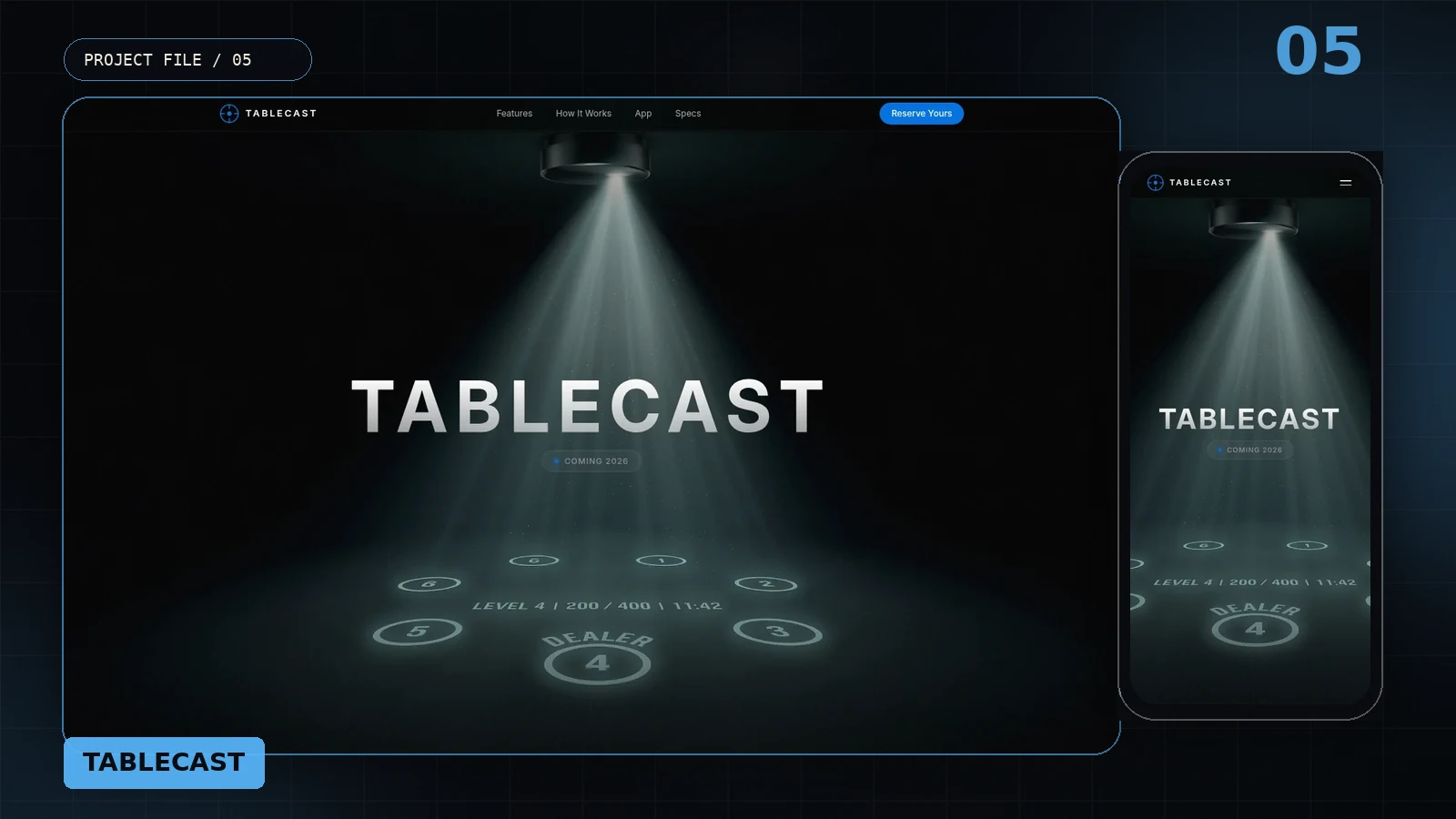
Home poker has a user-interface problem disguised as a pile of objects.
The dealer button goes missing. Blind levels live on one person's phone. The timer is visible to nobody. Seat numbers are improvised. Someone props a screen against a chip stack and calls it solved.
05.01
Make the table the screen
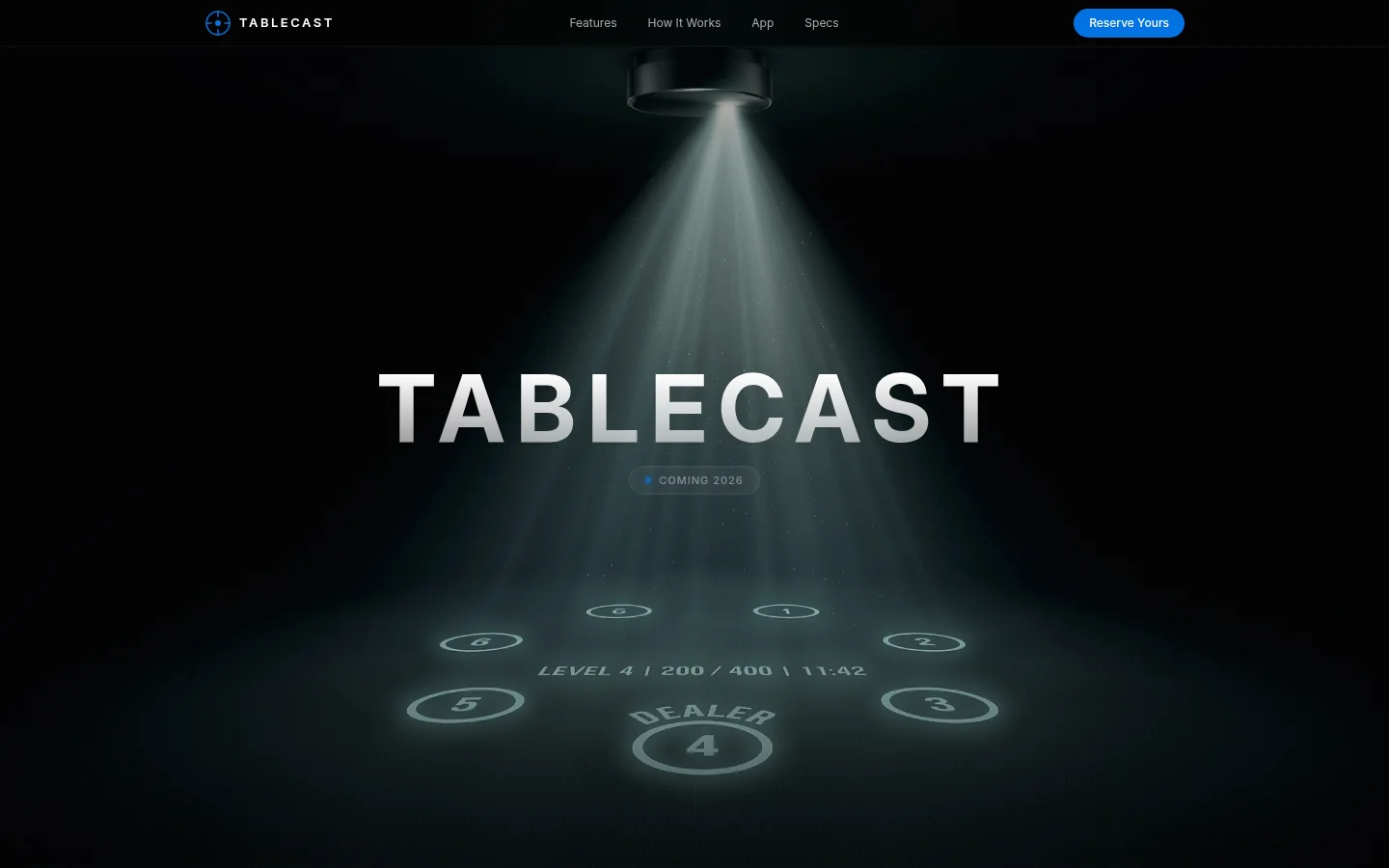
Tablecast moves the shared information to the only place every player is already looking: the felt. A compact unit mounts above the table and projects the dealer position, small and big blinds, ante, countdown, seat labels, breaks, and tournament status.
The setup model is intentionally simple: mount it, configure the tournament from the phone, then play. An optional physical remote can rotate the dealer, pause the timer, or start the next hand without reopening the app.
Interface movePut shared state in shared space.
05.02
The website came before the hardware
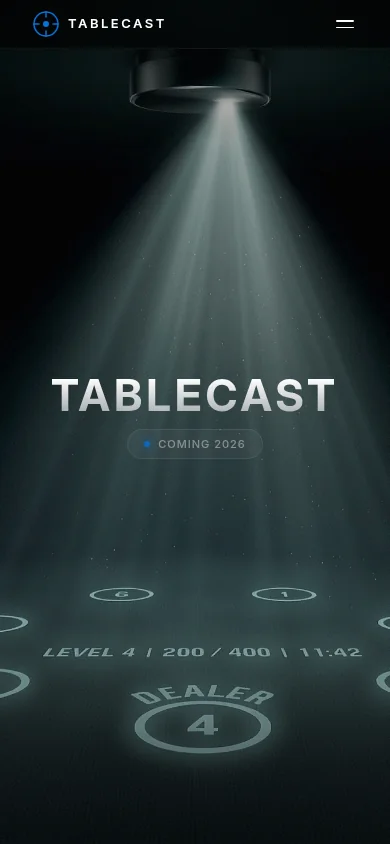
Building projection hardware is expensive. Explaining projection hardware is cheap. So the first working artifact was a static product prototype that made the idea visible enough to critique.
The site shows the light cone, the felt projection, the control model, the six core features, and the three-step setup. It also creates a reservation path. That is enough to test whether people understand and want the product before solving enclosure tooling or supply chains.
05.03
The unsolved parts are physical
A convincing render does not prove brightness in a real room. It does not prove that hands and heads will not interrupt the projection, that a ceiling mount works in enough homes, or that latency stays invisible during a game.
Those are not reasons to avoid the concept. They are the reasons to avoid pretending the concept is finished. The landing prototype narrows the expensive questions down to a testable hardware list.
Still to proveBrightness, occlusion, mounting range, control latency, and manufacturing cost.
05.04
A good concept prototype creates a mental movie
The strongest response to Tablecast is not a compliment about the site. It is someone immediately picturing their own table with the dealer marker glowing in front of them.
That is the job of an early concept: make the future concrete enough that people can object to the right things.
What survived
Three things I would carry into the next build
- Shared state belongs where the group already looks.
- Prototype the mental movie before the expensive mechanism.
- A concept gets stronger when the unknowns are named, not hidden.