Project File / 04 / AI product concept
What if doomscrolling made you better at business?
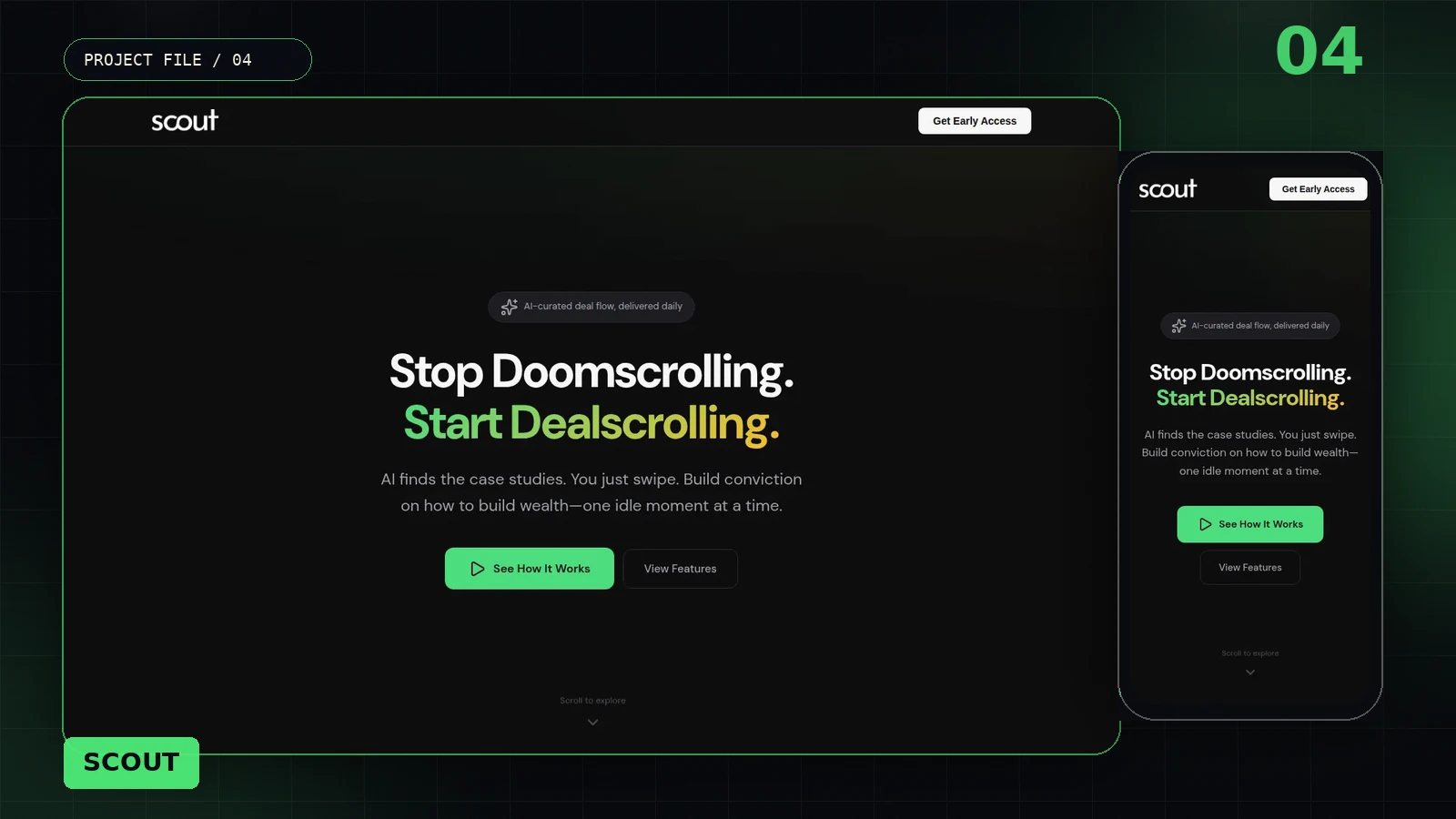
A product concept for a swipeable feed of real business case studies, designed to turn idle scrolling into pattern recognition.
I can lose twenty minutes to a feed with nothing to show for it except a suspiciously strong opinion about someone else's kitchen renovation.
Scout asks whether the mechanics of that feed can be redirected. Same low effort. Same one-more-card rhythm. Different residue: business models, pricing ideas, acquisition patterns, and proof that someone somewhere made the strange idea work.
04.01
Dealscrolling, not doomscrolling
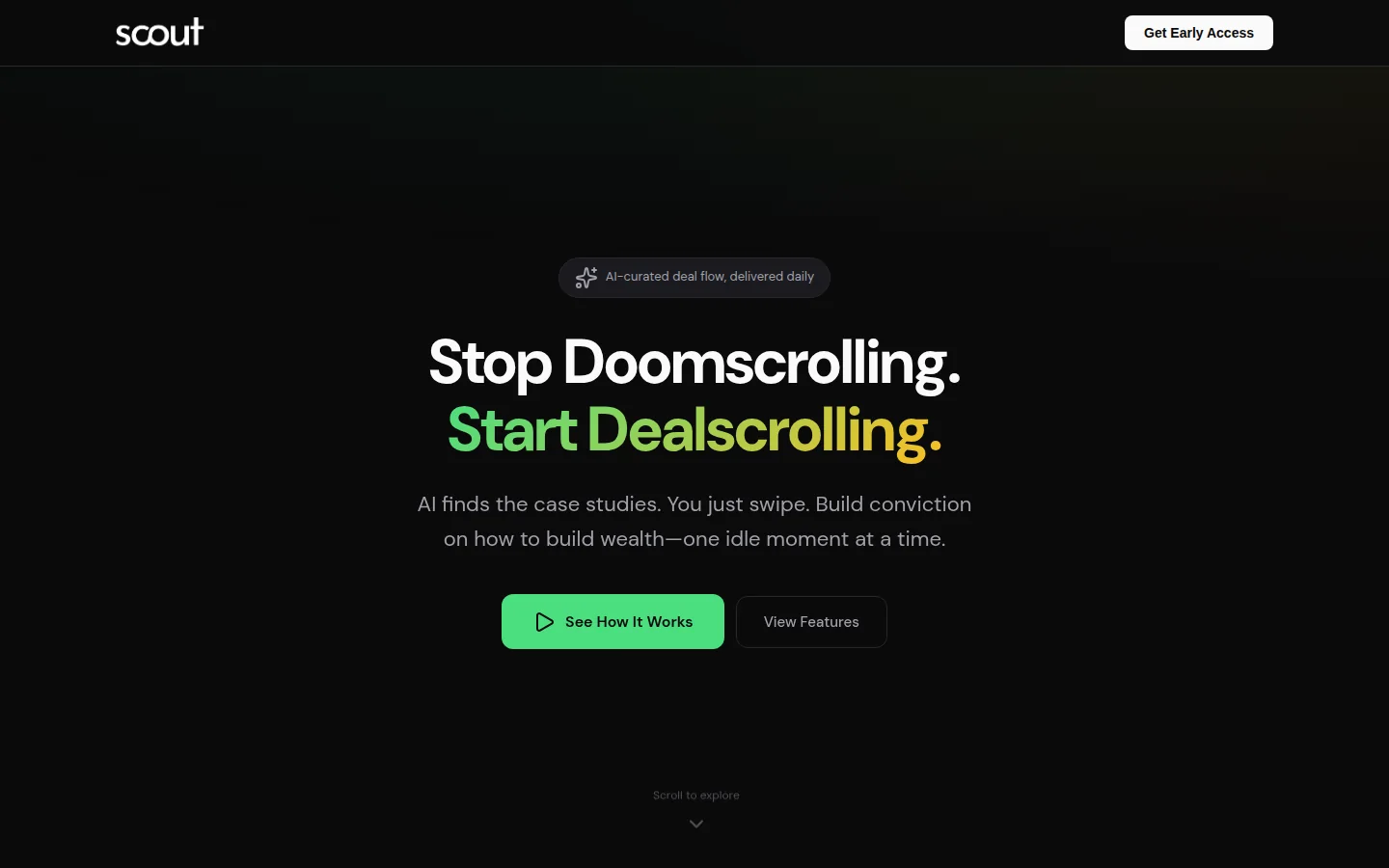
Scout is designed around AI finding business case studies across founder communities, Reddit, and podcasts, then turning them into a swipeable stack. The public site explains that proposed loop; it does not yet prove the application or ingestion pipeline.
A single card should answer enough to create a useful thought: what the company sells, who pays, why it works, and which part of the model is worth stealing ethically.
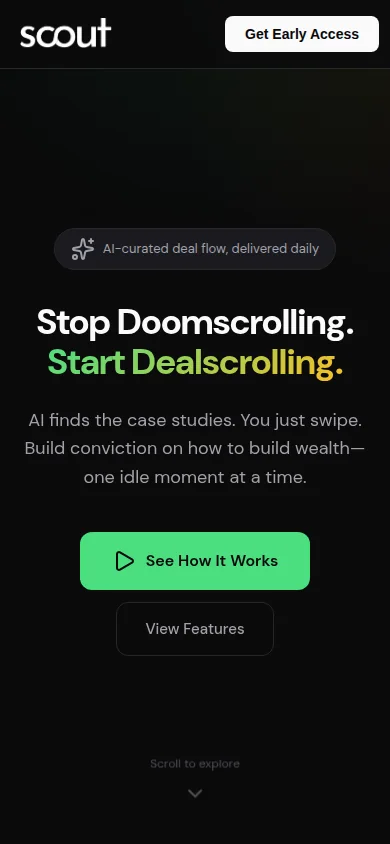
Product lineStop doomscrolling. Start dealscrolling.
04.02
The feed is the teacher
Traditional business education starts with categories. Scout starts with examples. Swipe through enough of them and patterns begin to repeat: boring software with expensive customers, marketplaces that begin as services, newsletters that become databases, tools that sell the workflow around a file format.
The profile and saved views turn those moments into a personal pattern library. The value is not the individual card. It is the conviction that develops after seeing the same shape work in six unrelated markets.
04.03
AI slop was the obvious failure mode
An AI summary can sound specific while saying nothing. For Scout to be useful, the source matters. The case study has to point back to evidence rather than laundering a vague claim through confident prose.
That makes curation and provenance more important than generation volume. A smaller stack of traceable examples beats an infinite feed of plausible businesses that dissolve when you look for the numbers.
Quality barA card should leave you with a model to inspect, not motivation to forget.
04.04
The prototype proves the habit, not the company
The live concept site makes the mental movie clear: arrive, understand the promise, see how the proposed swipe loop would work, and decide whether this is a better use of dead time.
The harder product questions come next: how much evidence belongs on a card, when a pattern deserves its own collection, and whether the product helps someone make a move rather than merely collect interesting facts.
What survived
Three things I would carry into the next build
- You can reuse an addictive interaction without reusing its objective.
- Examples teach patterns faster than categories do.
- AI summaries need visible provenance or they become decorative certainty.