Project File / 07 / Applied AI system
I kept getting websites that followed the prompt and missed the point
A prompt compiler became a working AI prototyping system that starts with the real repository, runs a bounded implementation, and demands rendered evidence.
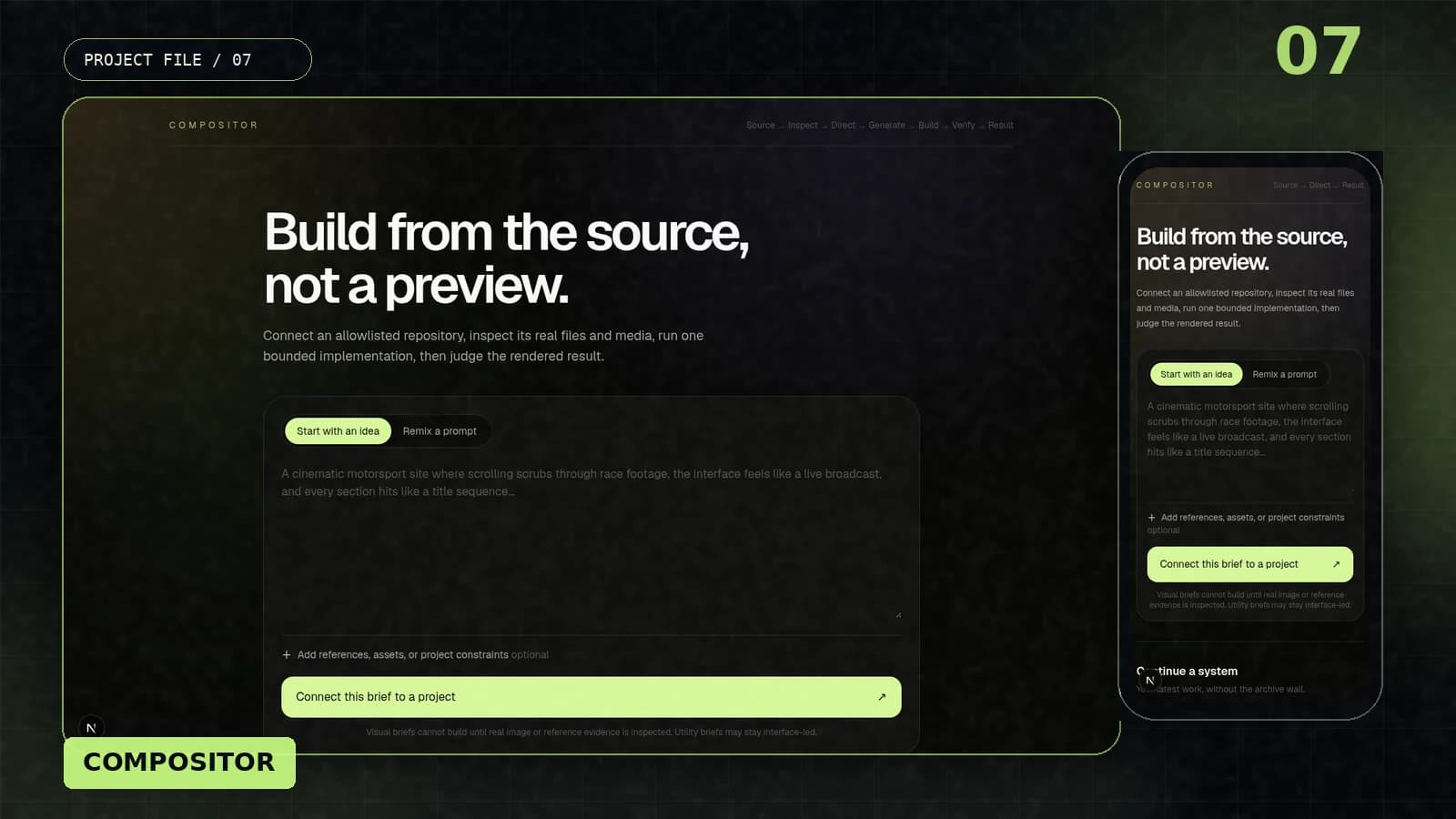
I could ask a coding agent for a cinematic website and get a valid implementation that looked like a dark landing page with a gradient. The prompt was followed. The point was gone.
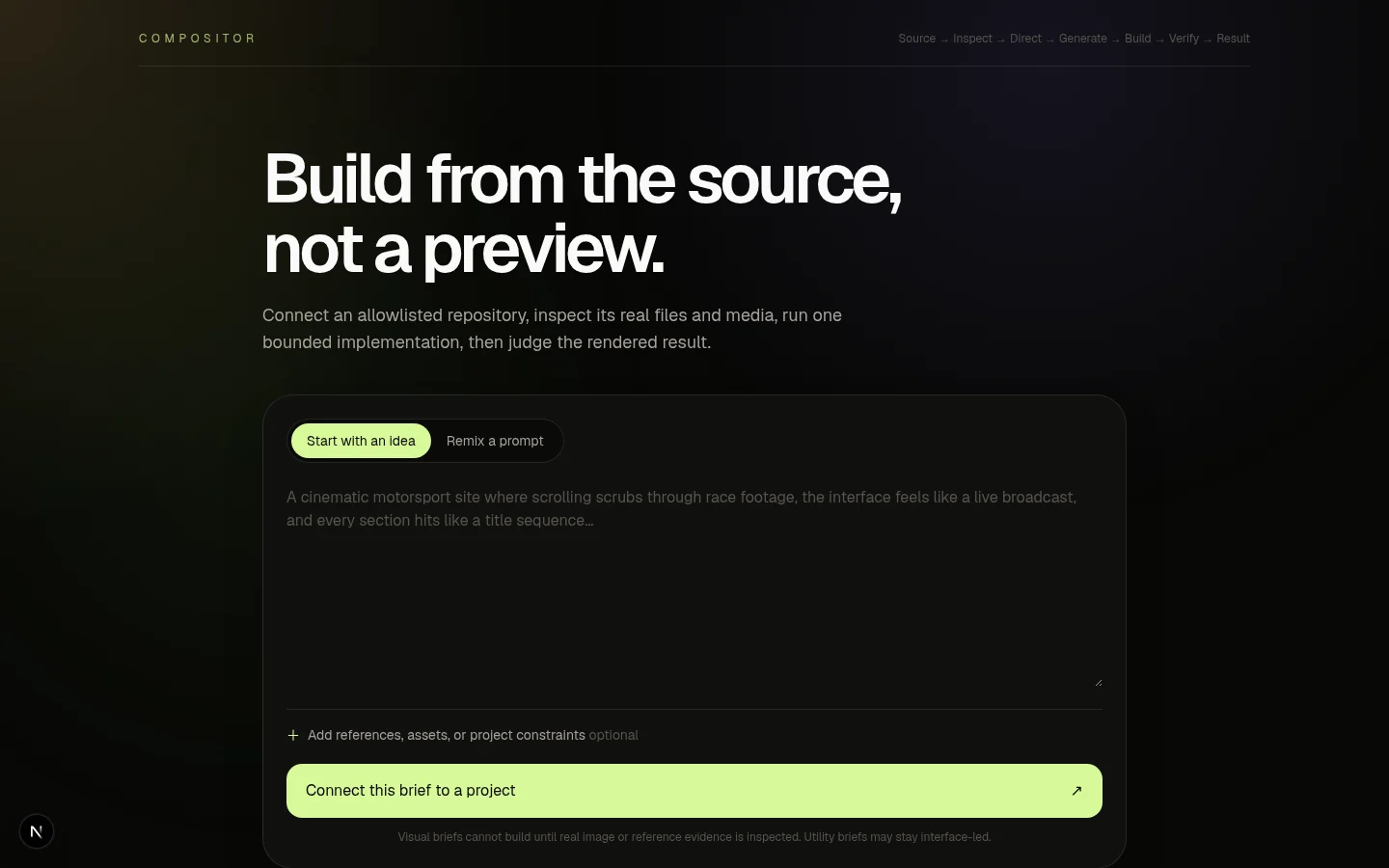
Compositor started as a way to make better prompts. It became something stricter: a private system that inspects the actual source, gives the build a bounded workspace, and refuses to treat a successful command as proof of a successful result.
07.01
A prompt is not a source of truth
The first versions focused on direction. They turned a rough idea into a premise, visual rules, motion choreography, and implementation language. That made the request more specific, but specificity still did not tell the agent what was already in the repository.
The useful turn was source-first. Compositor now starts with the real files, media, package scripts, git state, and workspace constraints. A brief can add intent, but it cannot quietly replace the product that already exists.
System ruleInspect the source before proposing the transformation.
07.02
The runner needed hard boundaries
Giving an agent shell access is easy. Giving it the right shell access is the product. Compositor resolves projects through an allowlisted workspace registry, pins execution to the inspected repository, rejects stale evidence, and limits each run instead of creating an open-ended loop.
The working loop is prompt → pipeline → result, but every transition is explicit. Those constraints are less glamorous than the visual compiler, but they are what make the system usable. A beautiful direction attached to the wrong folder is still a failure.
07.03
Execution and visual verification are different events
One of the most important fixes was teaching the system that a completed agent run does not mean the interface is good. Build output proves compilation. Git evidence proves a change happened. Neither proves hierarchy, originality, responsive behavior, or the absence of ugly artifacts.
Compositor records implementation evidence, then treats the rendered result as a separate review surface. The current suite covers source inspection, bounded execution, originality baselines, route safety, and result evidence. At publication, 147 tests passed.
Hard-won distinctionDone running is not the same as done building.
07.04
It is deliberately not a public magic box
Compositor still depends on a private owner gate, an allowlisted local runner, and judgment at the visual review step. Turning it into a public service would require isolation, quotas, billing, abuse controls, and a much narrower promise.
For now it is more valuable as an honest workshop tool. It makes the build process less vague without pretending taste can be reduced to one giant prompt.
What survived
Three things I would carry into the next build
- The repository is part of the prompt, whether the prompt admits it or not.
- A successful command is evidence of execution, not quality.
- Agent autonomy gets useful when the workspace and stopping conditions are explicit.