Project File / 14 / Client product work
Aviation software has no room for decorative ambiguity
Product design and frontend work completed in 2026 for aircraft owners and maintenance teams, where inspections, work orders, and records have to stay clear under operational pressure.
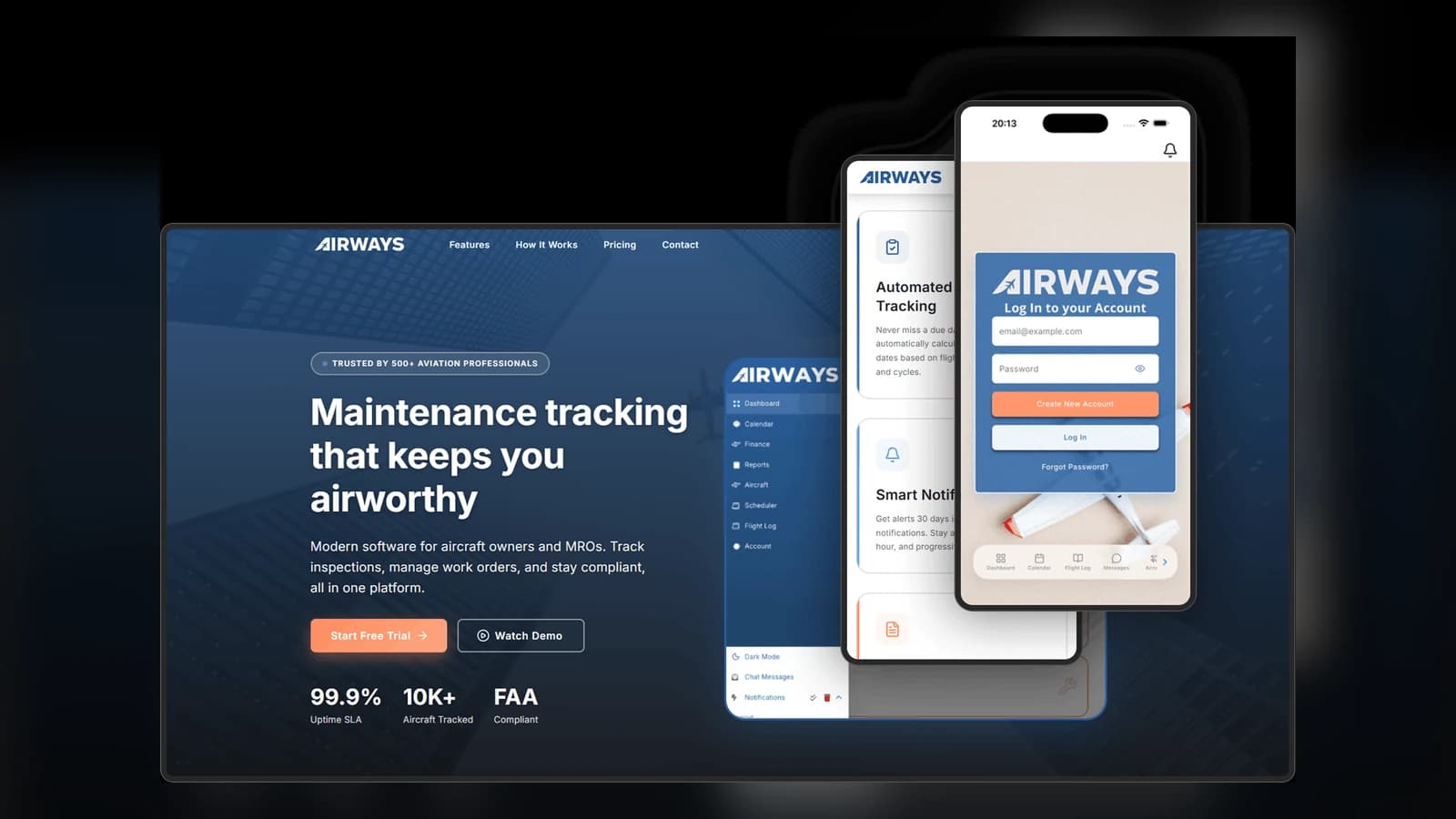
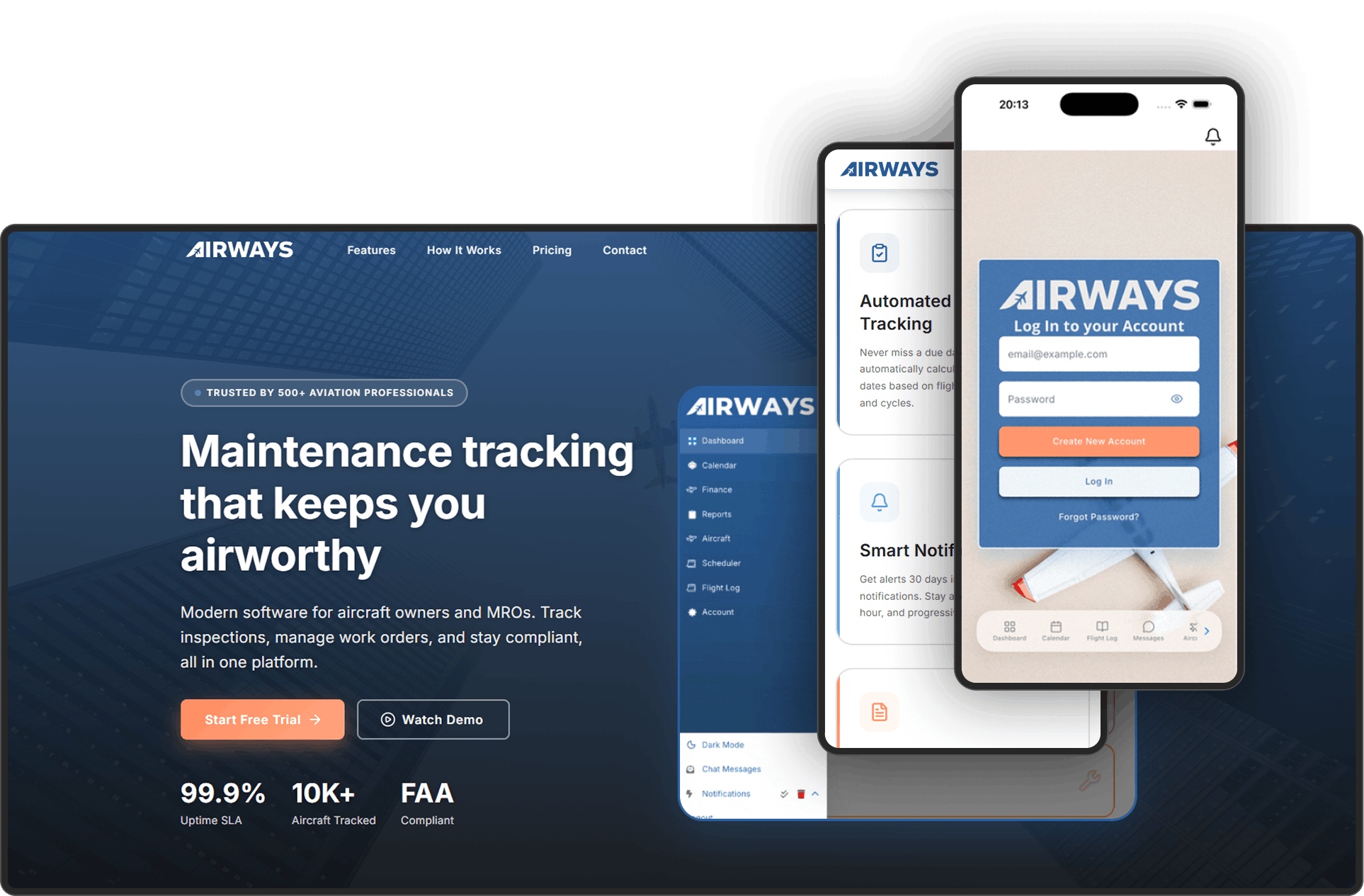
Airways is maintenance tracking software for aircraft owners and MROs. The public product promise is practical: track inspections, manage work orders, keep maintenance history accessible, and stay ahead of compliance. My role sat across product design and frontend delivery.
From 2025 to 2026, I worked as an autonomous embedded contributor, taking uncertain requirements into responsive interfaces and reusable product patterns. The useful proof is not an invented feature list. It is the way I work: clarify the decision, prototype the behaviour, build the interface, and stay through the awkward states.
14.01
The interface carries operational consequences
The public Airways surface names the core jobs clearly: inspection tracking, work orders, maintenance history, notifications, and compliance reporting. These are not decorative dashboard categories. Each one represents a decision that needs to remain legible when time, records, and responsibility are involved.
That changes the design standard. The product has to make current state, next action, and exceptions obvious without turning every screen into a wall of warnings. Clarity is not a visual preference here. It is the product doing its job.
Clarity testCan the person responsible see what matters next without decoding the interface first?
14.02
Design and frontend are one feedback loop
My work runs from UX and visual design into responsive implementation. I use interactive prototypes to resolve behaviour early, then stay close enough to the frontend that content pressure, edge states, accessibility, and narrow screens do not become someone else's cleanup.
That loop is especially useful when requirements are still moving. A prototype exposes a weak interaction quickly. A working interface exposes the assumptions the prototype hid. Moving between both keeps the product decision attached to the released behaviour.
14.03
Reusable patterns reduce repeated judgment
A maintenance product repeats the same structural problems across records, schedules, actions, states, and alerts. Reusable patterns make those repetitions coherent, but only when they include real content, error states, long labels, and responsive behaviour.
My role includes turning uncertain requirements into practical product decisions while balancing user value, business goals, and maintainability. The strongest pattern is not the one with the most variants. It is the one another screen can use without reopening the original argument.
System ruleReuse should remove uncertainty, not merely copy appearance.
14.04
This file stops where the client work becomes private
This was client work completed in 2026. The public site and portfolio image establish the product category and my operating range, but this file does not publish private product screens, unreleased features, roadmap details, user information, internal metrics, or confidential team decisions.
That boundary keeps the proof honest. The public signal is the work itself: product design, responsive frontend implementation, interactive prototyping, reusable systems, and autonomous ownership inside a complex operational domain.
What survived
Three things I would carry into the next build
- Operational clarity is a product outcome, not visual polish.
- Frontend fluency makes product-design decisions survive real states and screen sizes.
- Client proof can show operating range without exposing private product work.