Project File / 10 / Game system
I designed the aquarium before I built the game
A space-creature game idea became a production reference for the loop, life stages, food chain, invaders, stations, loot, and art rules.
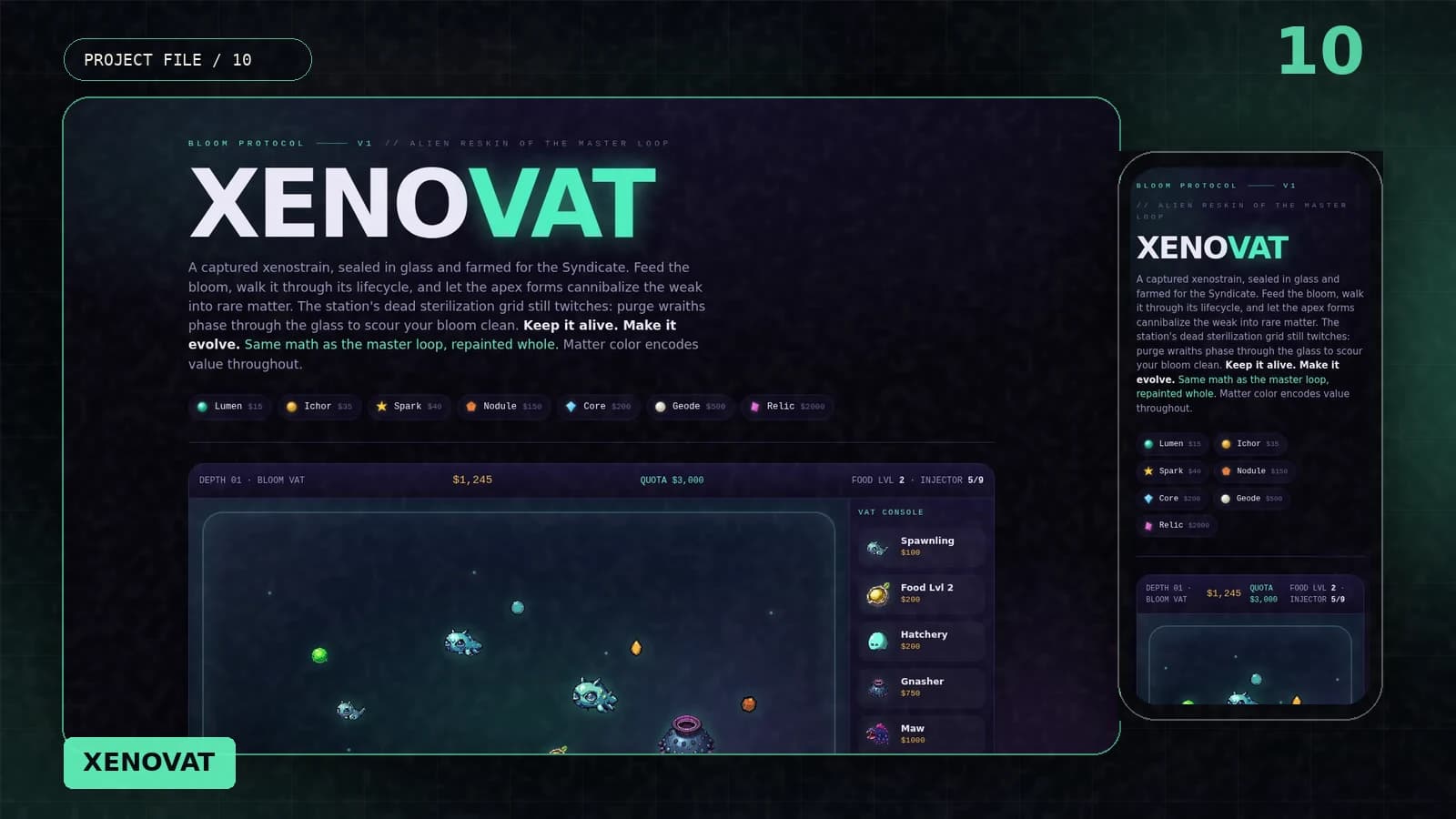
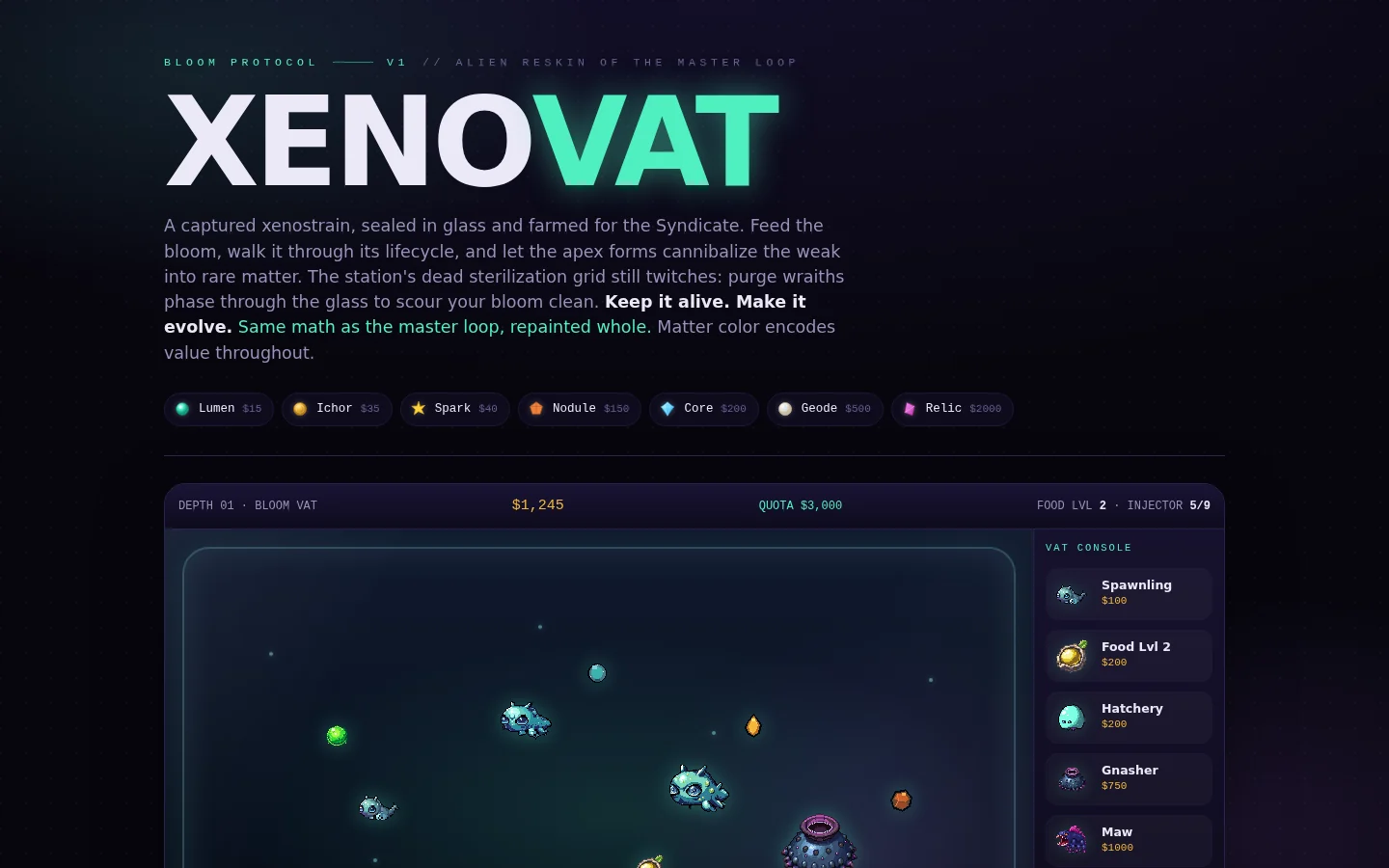
The idea was simple to describe: Insaniquarium in a strange orbital lab. Hatch captured organisms, keep them alive, feed them, protect the tank from invaders, and harvest what they produce to fund the next cycle.
The problem was that every new creature sketch invented a slightly different game. Xenovat needed a shared production truth before it needed more code.
10.01
The loop came before the lore
Xenovat is organized around a repeatable tank cycle: acquire or hatch a xenostrain, feed it through visible life stages, survive pressure, collect its output, meet a quota, and reinvest in the lab. The fiction exists to make that loop feel inevitable, not to replace it.
Putting the loop on one board exposed missing rules quickly. What counts as food? When does a creature mature? What does an invader threaten? Which drop pays the quota and which one upgrades the system?
Design orderIf the loop is vague, more creatures only create more vagueness.
10.02
Creature art needed lineage, not isolated prompts
A hatchling, juvenile, adult, and elder should look like the same organism changing under pressure. Generating each sprite independently made attractive aliens with no family resemblance.
The production board keeps stages, color logic, silhouettes, roles, and related assets visible together. That makes drift obvious before a disconnected image enters the game pipeline.
10.03
The reference board became an operating surface
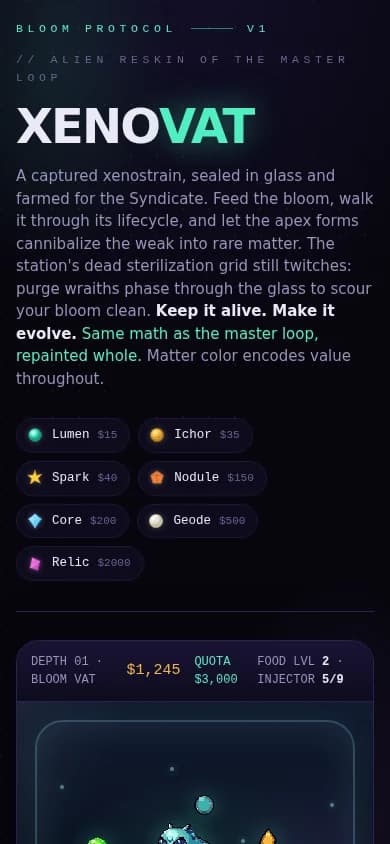
The live artifact contains the master loop, creature state board, hatchery stages, food icons, invaders, stations, matter tokens, asset links, and tracker status. The tracker has 147 rows: 24 complete, 4 exported, and 119 still in backlog. It is intentionally static and marked noindex.
That sounds less exciting than a game build, but it is the part that lets design, art generation, and a future Unity implementation refer to the same nouns and the same files.
Current truthA production reference can be real software without pretending to be the final game.
10.04
The game still has to earn its first ten minutes
A coherent board does not prove that feeding feels good, the tank stays readable, quotas create tension, or the first invasion arrives at the right moment. Those are interaction and balance questions.
The next honest milestone is a small playable tank with one creature lineage, one food source, one invader, and one upgrade. The production system has done its job when that slice can be built without reopening the entire fiction.
What survived
Three things I would carry into the next build
- Design the repeatable loop before expanding the universe.
- Generated assets need lineage rules, not just style prompts.
- A good production reference turns imagination into shared constraints.